The Large Magellanic Cloud is a nearby dwarf galaxy and a prominent companion of the Milky Way.
Its irregular structure contains extensive concentrations of stars, gas, and dust, creating a rich environment for stellar activity.
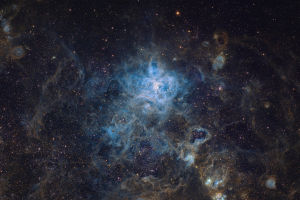
Within this galaxy, the Tarantula Nebula, also known as 30 Doradus, is one of the most remarkable regions of active star formation.
A Distinctive Galactic Structure
Unlike spiral galaxies with clearly defined arms, the Large Magellanic Cloud has an irregular form shaped by the uneven distribution of its stars and interstellar material. Bright stellar populations are interspersed with clouds of gas and dust, while luminous nebulae mark areas influenced by energetic young stars.
Its relative proximity provides astronomers with an opportunity to examine individual structures in substantial detail. Observations of these regions help reveal how stars, gas, and dust interact within a dwarf galaxy.
The Tarantula Nebula
The Tarantula Nebula is the most prominent star-forming complex in the Large Magellanic Cloud. It contains ionized gas, molecular material, young stars, and numerous massive stellar populations.
Radiation from hot young stars energizes the surrounding gas, producing much of the region's intense luminosity. Observations at infrared, radio, and millimeter wavelengths also reveal cooler and denser material that cannot be fully examined through visible light alone.
Star Formation Throughout the Galaxy
The Tarantula Nebula is not the only site of stellar formation within the Large Magellanic Cloud. Other regions contain clouds of gas and dust that provide material from which new stars can develop.
Once massive stars form, their radiation and stellar winds can alter nearby interstellar material. These interactions influence the shape and physical conditions of surrounding clouds, linking stellar development with changes across the wider galactic environment.
Reading the Wide-Field View
A wide-field image presents the Large Magellanic Cloud as an interconnected system of stars, nebulae, and interstellar clouds. The Tarantula Nebula stands out as a particularly luminous feature within this broader landscape.
However, a wide-field view cannot resolve every stage of stellar formation. Smaller structures, including dense molecular regions and young stellar objects, require observations with greater resolution and sensitivity across multiple wavelengths.
A Nearby Laboratory for Astronomy
The Large Magellanic Cloud offers an unusually detailed view of stellar populations and galactic structure. Its proximity allows astronomers to connect large-scale observations of the galaxy with detailed studies of individual star-forming regions.
At the heart of this environment, the Tarantula Nebula provides an especially vivid example of active stellar birth. Together, the galaxy and its luminous nebula demonstrate how stars emerge from interstellar material and become part of the evolving structure of a galaxy.