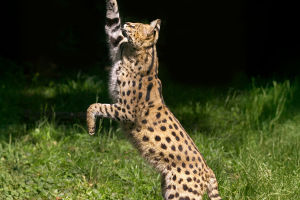
A rustle in tall grass can hide an entire story. In many open wetlands and grassy plains, a slim spotted cat pauses, ears twitching like small satellite dishes. For a few seconds it stands completely still, listening. Then suddenly it springs straight into the air—sometimes more than two meters high—and lands precisely where the sound came from.
That remarkable hunter is the serval, one of the most intriguing small wild cats on Earth. Unlike many other wild cats that rely mostly on sight, the serval is built to hunt through sound. Its oversized ears, long legs, and athletic jumps make it a specialist in environments filled with thick grass and hidden prey.
Understanding this animal reveals just how creative nature can be when designing a hunter.
Built for Listening
1. Oversized ears with precise hearing
Servals have some of the largest ears relative to body size among wild cats. Each ear can rotate independently, allowing the animal to pinpoint tiny movements beneath grass or soil. Researchers observing servals in savanna habitats have documented them locating rodents even when the prey is completely hidden from view. A faint rustle or scratch is often enough to guide a successful strike.
2. Advanced sound triangulation
The ears function almost like a biological radar system. By adjusting the angle of both ears, a serval can triangulate the exact location of a sound source. This ability is especially useful in tall grasslands where visibility is limited. Instead of chasing randomly, the cat calculates where prey is hiding before making a move.
3. A silent approach
Servals combine their hearing with extremely careful movement. Their padded paws allow them to step quietly through vegetation. Many hunts involve a slow approach followed by a sudden vertical leap, rather than a long chase across open ground.
Extraordinary Jumping Ability
1. Long legs designed for height
The serval's legs are unusually long compared with its body size. This structure allows the animal to jump straight upward about two to three meters. Such vertical leaps help the cat land directly on hidden prey or surprise birds attempting to take flight.
2. Precision landing technique
The leap is only part of the strategy. Servals often extend their forepaws forward during the jump so they can strike the ground exactly where they heard movement. Observational studies have recorded impressive success rates, sometimes capturing prey in nearly half of their hunting attempts.
3. Flexible spine and balance
Their spine bends easily, helping them adjust direction mid-jump. Combined with strong hind legs, this flexibility allows them to change posture in the air and land with remarkable control.
A Master of Wetland Habitats
1. Preference for tall grass and wetlands
Servals commonly inhabit areas with dense grass, marshes, and riverbanks. These environments support large populations of small animals that hide beneath vegetation, making them ideal hunting grounds.
2. Diverse diet
Although rodents are a primary food source, servals are opportunistic hunters. They may capture birds, frogs, insects, and small reptiles depending on what is available. This flexible diet helps them adapt to seasonal changes in prey availability.
3. Active day and night
Servals can hunt both during daylight and nighttime hours. In many regions they become more active at dusk and dawn, when small animals are also moving through the grass.
Distinctive Appearance
1. A striking spotted coat
The serval's golden coat is covered with bold black spots and stripes. This pattern provides camouflage among broken shadows in grassland environments.
2. A surprisingly tall silhouette
Despite weighing only around 9 to 18 kilograms, servals appear tall because of their long legs. When standing upright, their body posture is higher than many other cats of similar weight.
3. A short tail for balance
Unlike many other cats with long tails, servals have relatively short tails. The tail still assists with balance during quick turns or jumps but does not extend far beyond the body.
Watching a serval hunt is a reminder that nature often rewards patience and precision rather than speed alone. A quiet pause, a twitch of the ears, and a carefully measured leap can be more effective than a long chase.
Next time you see footage or photographs of this elegant spotted cat standing alert in tall grass, notice the moment before it moves. That brief stillness is not hesitation—it is calculation. And within that quiet pause lies one of the most refined hunting strategies in the animal world.